Pruning saw
ARS pruning saws – Japanese saws that cut on the pull
Japanese saws cut on the pull stroke, which takes less effort and holds a truer line than the push-cutting European saws. The range covers 29 saws: folding models for carrying in a pocket, curved and straight-bladed models for garden work, and telescopic solutions for high branches.
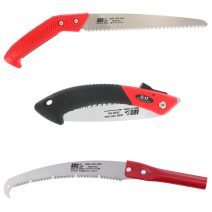
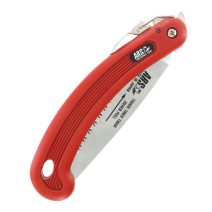
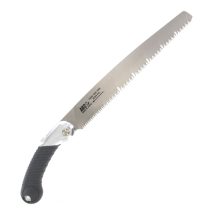
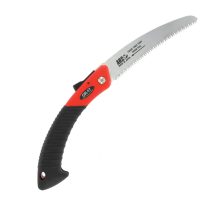
Which saw should you choose?
Folding or fixed blade?
Folding saws fit in a pocket or belt pouch, and the blade stores away safely. They are the best choice where sawing is not the main job, only the occasional branch that has grown too thick for your pruning shears. Fixed-blade models are carried in a holster, are stiffer and generally offer greater capacity.
Curved or straight blade?
A curved blade bites into the branch as you pull, which helps in a dense canopy or at an awkward angle. A straight blade gives a more even kerf on flat surfaces and in boarding work. On living wood the curved blade is generally more efficient.
Tooth pitch
The distance between the teeth. A larger 4.0 to 4.5 mm pitch cuts faster and more aggressively on thicker wood. A finer 3.5 mm pitch leaves a smoother cut face, which is an advantage on fresh, sappy wood and on ornamental trees.
TURBOCUT and Super TURBOCUT
ARS saws use three-sided, taper-ground TURBOCUT teeth. The more advanced Super TURBOCUT meets even less resistance in living wood, and the chip-clearing slots along the blade keep the kerf clean as you work. This matters on thicker branches, where trapped sawdust slows you down.
Important: impulse-hardened teeth cannot be sharpened
Several ARS saws have impulse-hardened teeth, which extends edge life several times over. The trade-off is that these teeth cannot be re-sharpened, because the hardened layer is very thin. On those models, replacing the blade is the correct answer when the teeth wear, not filing them. On those models, replacing the blade is the answer when the teeth wear. Saws without impulse-hardened teeth can be filed with the ARS 9F-10.
The ARS saw categories
| Category | What it is for | Typical models |
|---|---|---|
| Folding pruning saw | Pocketable, alongside pruning shears | 210DX, G-17, Z-17, G-18L |
| Curved pruning saw | Bites better in living wood, dense canopies | TL-24, TL-27, TL-30, UV-32E |
| Straight pruning saw | Even kerf, woodworking | Z-17, G-18L, PM-21L |
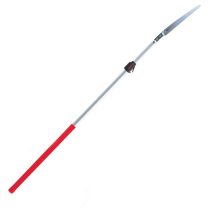
| Telescopic pole saw | High branches without a ladder | UV-34, UV-40, UV-47 on a pole |
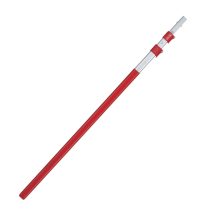
| Telescopic pole | Reach from 3.3 to 5.6 metres | EXP-3.3, EXP-4.5, EXP-5.5 |
Maintenance
Dried resin on the blade increases friction, so the cut takes noticeably more effort. Wipe the blade after use with the ARS GO-1 blade cleaner. Replacement blades are in the blades and saw blades category.
Frequently asked questions
Why do Japanese saws cut on the pull stroke?
Pulling takes less effort because the blade is under tension rather than buckling. That gives a truer line of cut and a cleaner cut face.
Can ARS saws be sharpened?
Only models without impulse-hardened teeth, using the ARS 9F-10. Impulse-hardened teeth cannot be re-sharpened; there, replacing the blade is the answer.
How thick a branch will ARS saws cut?
The range runs from 60 mm to 185 mm depending on the model. The exact figure is given on every product page.
How do I reach high branches?
With UV saws mounted on a telescopic pole, which reach from 3.3 to 5.6 metres, so there is no need for a ladder.