ARS curved pruning saws – bites in as you pull
A curved blade bites into the branch on the pull stroke, which helps in a dense canopy or at an awkward angle. On living wood this is the most efficient blade shape, which is why most ARS saws are built this way. The range covers 17 models with cutting capacities from 60 to 185 mm. For a pocketable version, see the folding saws.
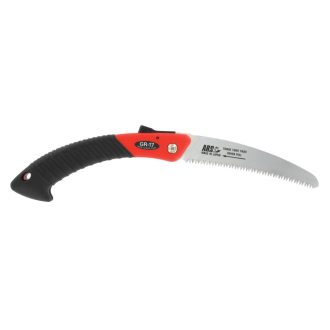
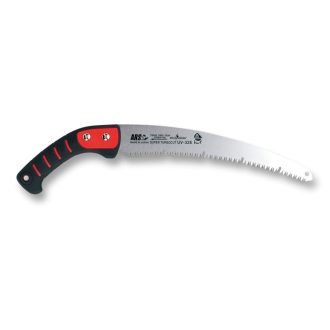
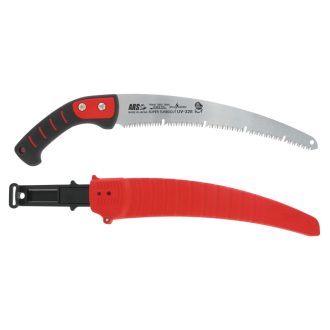
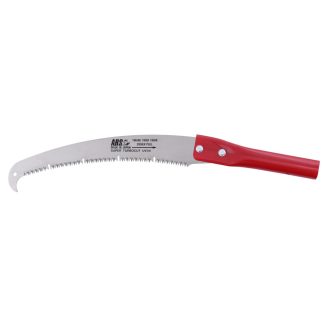
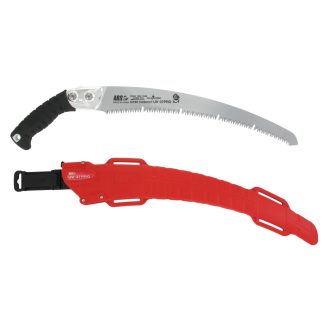
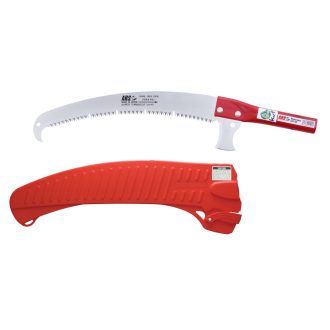
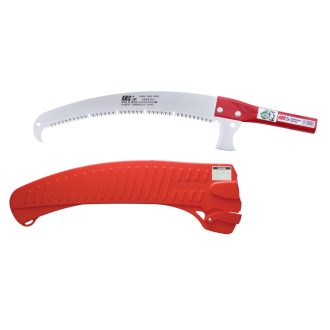
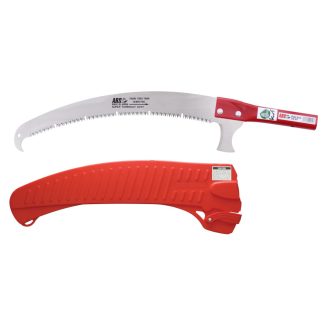
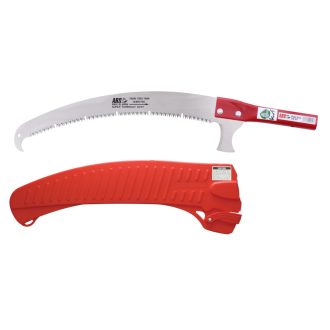
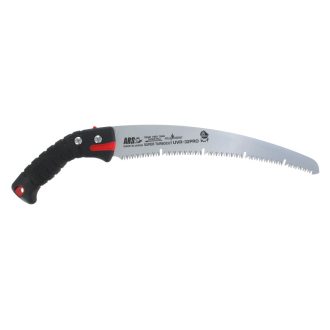
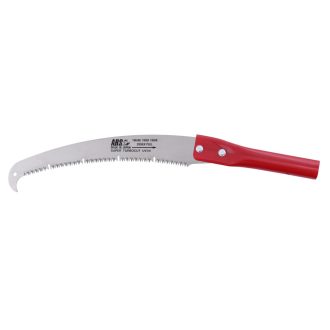
The larger curved saws
Fixed-blade models are carried in a holster, are stiffer and offer greater capacity than the folding versions.
| Model | Blade length | Cutting capacity | Teeth | Weight |
|---|---|---|---|---|
| TL-24 | 240 mm | 95 mm | Super TURBOCUT | 190 g |
| TL-27 | 270 mm | 105 mm | Super TURBOCUT, impulse-hardened | 200 g |
| TL-30 | 300 mm | 120 mm | Super TURBOCUT, impulse-hardened | 210 g |
| DUKE-25 | 250 mm | 100 mm | TURBOCUT | 250 g |
| CAM-24PRO | 240 mm | 95 mm | TURBOCUT, impulse-hardened | 280 g |
| UV-32E | 320 mm | 125 mm | Super TURBOCUT, impulse-hardened | 420 g |
| UVR-32PRO | 320 mm | 125 mm | Super TURBOCUT, impulse-hardened | 450 g |
| UV-37PRO | 370 mm | 145 mm | Impulse-hardened | 580 g |
TURBOCUT and Super TURBOCUT
TURBOCUT teeth are three-sided and taper-ground. The more advanced Super TURBOCUT meets even less resistance in living wood, and the chip-clearing slots along the blade keep the kerf clean as you work. This matters on thicker branches, where trapped sawdust slows you down.
Important: impulse-hardened teeth cannot be sharpened
Several ARS saws have impulse-hardened teeth, which extends edge life several times over. The trade-off is that these teeth cannot be re-sharpened, because the hardened layer is very thin. On those models, replacing the blade is the correct answer when the teeth wear, not filing them. The table above marks which models are impulse-hardened. Replacement blades are in the blades and saw blades category, and saws without impulse-hardened teeth can be filed with the ARS 9F-10.
For high branches
The UV series can be used as hand saws or mounted on a telescopic pole, putting high branches within reach without a ladder. See the full selection in the telescopic pole saw category.
Frequently asked questions
Why is a curved blade better on living wood?
As you pull, the curve makes the teeth bite into the branch on their own, so the cut proceeds with less effort and more stability, especially from an awkward angle.
Which curved saw should I choose?
Based on the thickness of the branches: for garden work the TL-24 or DUKE-25, for thicker branches the TL-30 or the UV series.
Can these saws be sharpened?
Only those without impulse-hardened teeth. On impulse-hardened models, replacing the blade is the answer.